Table of Contents
Trappist Beer
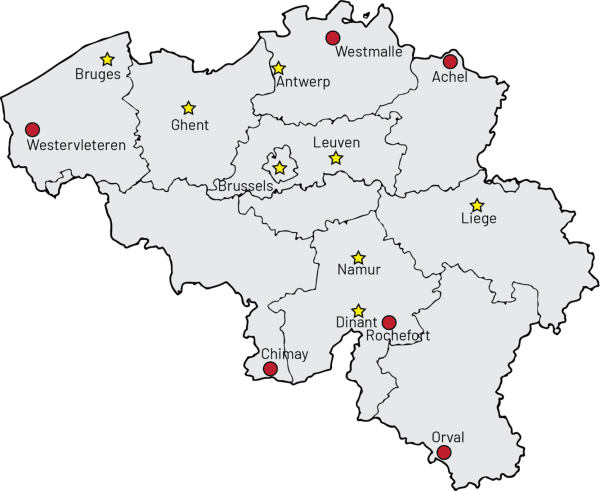
Brewed in an exclusive club of 15 monasteries worldwide, 5 of which are in Belgium (more than any other country), Trappist beer offers the chance to taste a way of life, unchanged for centuries.
What makes a Trappist beer?
The short answer is that it describes who is making the beer and where, not the type of beer itself.
The Trappist name is governed by the International Trappist Association (ITA), only breweries that meet their requirements are able to use the Trappist name and their Authentic Trappist label.
 The ITA requirements for the ITA label are:
- The product must be made within the immediate surroundings of the abbey
- Production must be carried out by, or under the supervision of monks or nuns
- Profits should be intended for the needs of the monastery, the Trappist Order or for other development projects and charity work.
Who are Trappists?
Trappists are followers of the Order of Cistercians of the Strict Observance or Ordo Cisterciensis Strictioris Observantiae, often abbreviated as OCSO, originally called Order of Reformed Cistercians of Our Lady of La Trappe, hence the name Trappist.
The OCSO is a Catholic religious order of cloistered monastics, or monks who live in a monastery. The order was founded in La Trappe Abbey in Normandy in 1664.
During the French Revolution many of the monks fled france and moved to Belgium, and re-established the monasteries there, many of which still exist today. A core tenet of the Trappist order is the Rule of Saint Benedict, which dictates that monasteries must be self-supporting through manual labor.
It is important to remember that all the breweries listed below are located at active monasteries, which are important religious sites to the monks who have dedicated themselves to their faith. They are not primarily breweries or tourist attractions.
The 5 Trappist Abbeys of Belgium
Westvleteren
Brouwerij Westvleteren at Saint Sixtus Abbey in Vleteren in Flanders. They brew very small amounts of beer, and sell only to individuals, in person at the brewery café or online.
“As every man we must be able to live. So we have to try to earn our living and let others share in what we have to abstain from. Indeed, we have to live 'from' and 'with' our brewery. But we do not live 'for' our brewery. This must be strange for business people and difficult to understand that we do not exploit our commercial assets as much as we can. We are no brewers. We are monks. We brew beer to be able to afford being monks.” -Father abbot, Saint Sixtus Abbey
| Abbey | Saint Sixtus Abbey |
|---|---|
| Location | Vleteren, West Flanders |
| Brewing since | 1839 |
| Beers | Blond (5.8%), 8 (8%), 12 (10.5%) |
| Beer style | Singel, Dubbel, Quadrupel |
| Availability | Online webshop only (pre-registered, 1 order/vehicle/day); collect at abbey or Belgium-only home delivery; six-packs at In de Vrede café; resale forbidden |
Chimay
Brewed at Scourmont Abbey in Hainaut in Wallonia since 1862, Chimay is probably the most famous of the Belgian trappist breweries. The 3 Chimay beers are widely available in Belgium and abroad. They also have a cafe and restaurant on site, Espace Chimay.
You can stay near the abbey and brewery at their inn, Auberge de Poteaupré (Affiliate link). Auberge de Poteaupré also has a brasserie and restaurant.
| Abbey | Scourmont Abbey (Notre-Dame de Scourmont) |
|---|---|
| Location | Forges-lez-Chimay, Hainaut |
| Brewing since | 1862 |
| Beers | Rouge/Red (7%), Triple/Cinq Cents (8%), Bleue/Blue (9%) |
| Beer style | Dubbel, Tripel, Belgian Dark Strong Ale |
| Availability | Widely exported, ~50% sold abroad |
Click here for the Chimay beer main page
Westmalle
| Abbey | Abbey of Our Lady of the Sacred Heart |
|---|---|
| Location | Westmalle, Antwerp |
| Brewing since | 1836 |
| Beers | Extra (4.8%), Dubbel (7%), Tripel (9.5%) |
| Beer style | Patersbier, Dubbel, Tripel |
| Availability | Widely available; created the modern Tripel style |
Rochefort
| Abbey | Abbey of Notre-Dame de Saint-Remy |
|---|---|
| Location | Rochefort, Namur |
| Brewing since | 1595 (current brewery from 1899/1952) |
| Beers | 6 (7.5%), 8 (9.2%), 10 (11.3%) |
| Beer style | Dubbel, Belgian Strong Dark Ale, Quadrupel |
| Availability | Widely available |
Orval
| Abbey | Abbaye Notre-Dame d'Orval |
|---|---|
| Location | Villers-devant-Orval, Luxembourg province |
| Brewing since | 1931 (current brewery) |
| Beers | Orval (6.2–6.9%) |
| Beer style | Belgian Pale Ale (dry-hopped, Brettanomyces) |
| Availability | Widely available; only brews one beer commercially |
Achele!
Saint Benedict Abbey of Hamont-Achel, where Achele is brewed, once had a trappist brewery however in 2021 the last two remaining monks left the abbey and the abbey lots its right to use the trappist label and in 2023 the abbey was bought by entrepreneur Jan Tormans. Tormans bought the abbey with the intention of focusing on brewing and increasing beer production.
Trappist Tradiations
To understand the story of Belgian beer you need to start with Trappist and monastery beer. Since 530AD and the Rule of Saint Benedict monks have brewed and sold beer. Before the 12th to 13th centuries monasteries were the only places that there was beer brewing on a commercial scale. The brewing and sale of beer supported the monastery then and now. The way they operate has changed over the years however the philosophy is the same. Today there remain 5 Trappist breweries in Belgium. The Trappists are a catholic order originating in La Grande Trappe Abbey in the French province of Normandy.